|
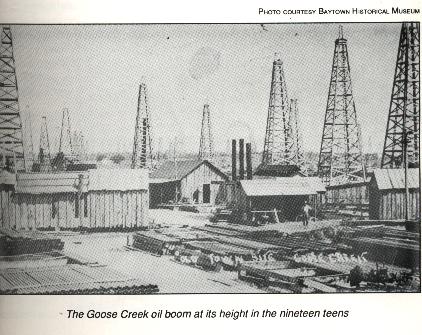
 Goose Creek was the name of a Post Office located in a store in what was known
as Old Town (Texas Avenue area) and was physically moved by the inhabitants of
New Town, so they could name their city Goose Creek. Goose Creek was the name of a Post Office located in a store in what was known
as Old Town (Texas Avenue area) and was physically moved by the inhabitants of
New Town, so they could name their city Goose Creek.
Oil was discovered in 1908 at the mouth of Goose Creek and Tabbs Bay and became
known as the famous Goose Creek Oil Fields.
The Goose Creek Oil Field became the first off-shore oil drilling in the state.
Goose Creek was 2 miles from Baytown (Lee College area) and separated from Pelly by
the Southern
Pacific Railroad Tracks and a drainage ditch.
Confederate Naval Works of Goose Creek
was established in the 1850's by brothers Captain Henry
Chubb and his brother Henry. Possibly 6 ships were built here and used to
support the South in the Civil War.
Read about it here!
Houses in New Town had to be constructed of brick, or stucco. Plots of land
were well laid out by Ross S. Sterling, a Chambers County store owner.
Goose Creek incorporated in April 1919. It's business district was the hub of
the Tri-Cities and was the Texas Avenue area.
In 1928, the city of Goose Creek covered only three-fourths of a square mile,
but had a population of 5000.
In March 1947, after a census was taken of Goose Creek (9,928), the city folded
into Pelly/Baytown (11,030) and officially ceased to exist and took the name
Pelly.
The first Mayor of Goose Creek was C. Q. "Kid" Alexander.
See the photos of
Goose
Creek here!
The Brunson theater and the Decker Drive-In were both
owned by local merchant Howard E. Brunson.
|
Name of Goose Creek will live on
By Wanda Orton Mar 22, 2024
While Goose Creek stream is not extremely deep, flowing lazily
toward the Houston Ship Channel, its name dips deeply into history –
and controversy.
I was attending Baytown Junior High in the late 1940s during the
hot-tempered feud concerning what to call the newly consolidated
Tri-Cities of Baytown, Pelly and Goose Creek. Naturally, we kids
favored the name Baytown while our chief rivals, the Horace Mann
Junior High kids, cheered for the name of Goose Creek. Standing a
stone’s throw from Goose Creek city limits, the Horace Mann campus
actually was grounded in Pelly.
When anyone spoke against naming the new city Pelly, the highly
respected former Pelly Mayor Fred Pelly’s feelings were not hurt. He
made it clear he wanted to stay out of the name-calling and didn’t
want to pick a favorite. However, when pushed, he admitted liking
the name Baytown.
Meanwhile, the Baytown/Goose Creek debate raged on. Baytownians
claimed their town was older – as far back as the 1850s – and
therefore deserved the honor. “No!” responded the Goose Creekers.
“Our town is older! That was the name going back to Dr. Harvey
Whiting’s time as far back as the Texas Revolution, the 1830s.”
Somehow, the Indian Connection came up with the recollection of an
old story. Centuries ago, according to the legend, Indians prowling
the area discovered the creek and named it Goose Creek. They saw
many geese floating on and flying over the waterway.
I’ve wondered about that. Totally different from the civilized
Cherokee and other smart tribes, the Karankawas were not the most
literate tribe in Texas history. It’s doubtful they spoke English
and knew how to utter even two little words such as Goose and Creek.
As well as the name advocates for Goose Creek or Baytown, the
controversy attracted independents, the free thinkers opting for
alternatives. How about Point Sterling or Lee City? Or Whiting or
Scott Burg? Oak Tree? And – preceding an industrial complex with
that name – Bay Port?
Voter acceptance of the new city charter in 1948, including the name
Baytown, ended the discussion officially, but not emotionally. Hard
feelings, at least from the Goose Creek side, remained. For a while,
it seemed as though the whole matter was déjà vu all over again as
school trustees struggled with the issue of retaining the name Goose
Creek for the district or renaming it Baytown.
A talking point for Baytown was the Baytown Refinery of Humble Oil &
Refining Co. (now Exxon Mobil) being known worldwide. A company
tanker named Baytown even circled the globe, gliding by foreign
tankers arriving at or departing from the Baytown Docks.
Goose Creekers argued that the district always had that name. It had
historical – plus sentimental – value. A name change also would
cause a ton of paperwork, reorganizing and confusion. And would Lee
College, then governed by the public school system, have to change
its name? Throughout the city, some necessary changes were being
made with the purpose of avoiding confusion. Examples: Goose Creek
First Baptist was becoming Memorial Baptist because there already
was a Baytown First Baptist … Goose Creek Street became North Main…
Goose Creek Hospital, Baytown Hospital … not to mention many
business places that updated their name to Baytown.
Surprisingly, though the district keeping its name, several teacher
and parent-teacher organizations have adopting the name of Baytown.
By now, locals may never have heard about the conflict between
Baytown and Goose Creek. I remember it because I was there – an
impressionable adolescent hearing a whole lot of arguing and
agonizing connected with our town’s name. Since I was born and
raised in Baytown, you probably know what side I was on.
Thankfully, I have mellowed out through the years. I have a deeper
understanding of why the Goose Creek loyalists felt so strongly
about their town and its identity. Goose Creek was their community,
their history. They had family members and friends who attended or
remembered the original Goose Creek High School, housed in the
building that later became the original Horace Mann Junior High.
Be proud, Goose Creek Memorial High School. Your name draws
attention to an important part of our history – the ability to work
together in spite of past differences. That’s the way it should be –
all for one and one for all – Baytown, Goose Creek and Pelly.
In the meantime, good ol’ Goose Creek stream, like Old Man River,
keeps rolling along …
Wanda Orton is a retired managing editor of The Sun. She can be
reached at [email protected], Attention: Wanda Orton
|
|
Goose
Creek TX goes away back
Used by permission of Wanda
Orton
Long
before incorporating as a city and becoming a part of the Tri-Cities
that included Pelly and Baytown, it was known as Goose Creek.
Proof is in
a letter written in 1836 by Dr. Harvey Whiting, who gave his address
as Goose Creek. Published a century later in the La Grange Journal,
the letter was written to Col. James Morgan about two weeks after
the battle at San Jacinto.
Whiting
wanted to tell his side of the story in regard to a brief but
desperate trip to Morgan’s Point to consult with Mexican Army Gen.
Santa Anna and Col. Juan Almonte. Before the battle at San Jacinto
on April 21, 1836, the Mexican troops headquartered at Morgan’s
Point.
You may know
that story. While Morgan was on military duty in Galveston,
fortifying the island for a possible invasion, the Mexican Army
invaded his own turf. Before they left, the troops cleaned out
Morgan’s warehouse, taking enough provisions to last a war time.
Moreover, Gen. Santa Anna added Morgan’s pretty housekeeper Emily
West (a.k.a. Emily Morgan, the Yellow Rose of Texas) to their
caravan.
Worried
about the safety of his family, Whiting decided to row his boat over
to Morgan’s Point for a little talk. All he wanted from the Mexican
Army was assurance his family would be safe.
FYI,
Whiting’s home and medical office were located in the vicinity of
present-day Bicentennial Park. All of that land later acquired by
the Pruett family – including the old oak tree on Texas Avenue --
originally belonged to Whiting.
After Santa
Anna promised not to kill his family, Whiting returned home to Goose
Creek. Mission accomplished.
However,
there were repercussions. Rumors began to circulate that Whiting was
in cahoots with the Mexican Army. His loyalty was questioned,
especially by rabble-rouser David Kokernot, who called Whiting an
old thief – and even worse, a Tory!
Though he
never fought in the Texan Army, Whiting did his part for the war
effort. Risking his life, he went to Lynchburg to save important
documents from the home of Republic of Texas President David G.
Burnet. He may have been a pacifist, but he was neither a thief nor
Tory.
In his
letter to Morgan, he aimed to make all that clear.
Until
researching the history of the Tri-Cities the other day -- prepping
for a story about the 97th anniversary of the city of
Goose Creek -- I didn’t know an entire community went by that name
long, long ago.
I should
have known.
In my history files in a
folder labeled city of Goose Creek, I had overlooked a faded
newspaper clipping from the Houston Chronicle describing the Whiting
letter, dateline Goose Creek, May 3, 1836.
Houston Wade, a Houston
Chronicle reader in 1937, provided that newspaper with information
from the La Grange Journal about the Whiting letter. He was
responding to a story in the Chronicle by Chester Rogers about the
origin of the name Goose Creek. Rogers had written that Indians
roaming this area named the stream Goose Creek.
The Indians really
started something – didn’t they? Their designation for a stream
inspired the naming of a settlement, then a city, hospital, school
district, country club, myriad business places and most recently,
Goose Creek Memorial High School.
What’s in a name?
In the case of Goose Creek, a whole lot of local history.
|
|
Goose Creek, the early
years, remembered
Used by permission of Wanda
Orton
The late Dr. Richard Woods wrote an
inspirational book about how to make friends -- the subject of
Wednesday's column -- but, as far as I know, the retired Baytown
dentist never authored a book about local history.
He could have. Having grown up on downtown
Texas Avenue where his father, John Lynn Woods, owned a pharmacy,
Dr. Woods was an eye-witness to Baytown history long before this
entire city was known as Baytown. The original, incorporated Goose
Creek claimed Texas Avenue, and the Woods pharmacy was called the
Goose Creek Pharmacy. Goose Creek represented part of the Tri-Cities
along with incorporated Pelly and unincorporated Baytown.
The Woods business stood at 126 W. Texas
across the street from a competitor, Herring's Drug Store, owned by
Garrett Herring.
John Lynn Woods, drawn by reports of the
oil boom in the Goose Creek field, moved to Pelly in 1917 and set up
shop.
With the city of Goose Creek thriving in
commercial and residential development, Woods decided in 1925 to
relocate his pharmacy to Texas Avenue. Dr. G.A. Lillie of Goose
Creek and Dr. John Bevil of Beaumont were his business partners
until he bought them out.
Richard Woods helped his father at work and
his mother at home by running errands, first riding over the
Tri-Cities on his bicycle and then driving the family car at the age
of 8. That's right - 8.
Once, when I was quizzing him about local
history, he described his father's place of business. He said round
tables filled the center of the building all the way from the front
to the back where the drug department was located. There were
old-style chairs, the type seen today in some ice cream parlors.
Ceiling fans whirled above the tables to keep the customers cool.
A fire in 1935 and another one in 1940
destroyed the building but following each fire, the drug store was
remodeled and modernized. Eventually booths replaced the tables. In
addition, customers had the option of bar stools at the lunch
counter.
Complete meals were served, and Dr. Woods
even recalled the price. For 25 cents, a customer could buy a meal
consisting of a meat, three veggies, a drink and dessert. Later,
when the price was increased to 35 cents, customers complained.
Dr. Woods also remembered a young man who
ran the lunch counter in the early years. That would be Harold
Scarborough, who went on to become a successful pharmacist and owner
of his own business, lastly on Market in old Baytown.
John Lynn Woods opened his drug store door
every day at 7 a.m. and locked up at 10 p.m. In addition to filling
prescriptions throughout the day, he managed the whole store and
kept the books with a quill-type pen.
Dr. Woods, continuing his review of
downtown in the old days, said Culpepper's Furniture Store occupied
the northwest corner of Texas and Ashbel. The second floor of the
building housed a hospital manned by medical doctors William Brooks,
C.H. Langford and L.A. Hankins, who later built the Goose Creek
Hospital on West Defee next to the Del Monte Hotel.
Just south of Culpepper's on Ashbel was Dr.
N.L. Dudley's ear-nose-throat clinic and hospital. Dr. H.I. Davis
eventually bought this structure and practiced there for many years.
East of the Goose Creek Pharmacy was the
American Barber Shop, Dr. Woods said, noting that the late Dr.
Herbert Duke came for his shave at 8 a.m. every morning,
administered by a barber named Duke Jones.
Lillie-Duke Hospital, at West Pearce and
Ashbel, was owned by Dr. Duke and John Lynn Woods' former business
partner, Dr. Lillie.
|
| GOOSE CREEK
OILFIELD. The first offshore drilling for oil in Texas occurred
along Goose Creek in southeast Harris County, twenty-one miles
southeast of Houston on Galveston Bay. In 1903 John I. Gaillard
noticed bubbles popping to the surface of the water at the point
where the creek empties into the bay. With a match he confirmed that
the bubbles were natural gas, a strong indication of oil deposits.
Royal Matthews leased the Gaillard property and drilled for 2½ years
but could not bring in a continuously producing well.
Not until a Houston-based
syndicate, Goose Creek Production Company, drilled on the marsh of
the bay was oil found, on June 2, 1908, at 1,600 feet. On June 13
the Houston syndicate sold out to Producers Oil Company, a
subsidiary of the Texas Company. After drilling twenty dry holes in
two years they abandoned the field. The American Petroleum Company,
new holders of a lease on Gaillard's land, finally drilled close to
the shore. On August 23, 1916, contractor Charles Mitchell brought
in a 10,000-barrel gusher at 2,017 feet. Initially the well produced
8,000 barrels daily, a quantity indicating that Goose Creek was a
large oilfield.
The community changed overnight as men rushed to
obtain leases, drill wells, and build derricks. Tents were
everywhere, teams hauled heavy equipment, and barges brought lumber
and pipe from Houston. Within two months the well leveled off to 300
barrels a day, but by December 1916 drilling along the shores of
Goose Creek, Tabbs Bay, and Black Duck Bay had raised production to
5,000 barrels daily. The flow of the average well drilled in 1917
was 1,181 barrels a day. The largest well of the field was Sweet 16
of the Simms-Sinclair Company, which came in on August 4, 1917,
gushing 35,000 barrels a day from a depth of 3,050 feet. This well
stayed out of control for three days before the crew could close it.
World War II oil prices of $1.35 a barrel encouraged Humble Oil and
Refining Company and Gulf Production Company to try offshore
drilling. The Goose Creek field reached its peak annual production
of 8,923,635 barrels with onshore and offshore drilling by 1918.
In 1917 Ross S. Sterling a
founder and president of Humble Oil (now Exxon, U.S.A.), bought the
Southern Pipe Line Company to route oil from the field to the
Houston Ship Channel Two 7,000-foot lines of four-inch pipe crossed
Black Duck Bay storage tanks and a wharf on Hog Island in the
channel. Since Goose Creek oilfield was a prospective long-term
producer, Humble constructed its major refinery, which was completed
by April 21, 1921, adjacent to the field and named the plant and
townsite Baytown. The Dayton-Goose Creek Railroad Company, built in
1918, connected the refinery to the Goose Creek field.
The Goose Creek field is a
deep-seated salt dome with overlying beds slightly arched; its
discovery spurred exploration for deep-seated domes, and led to the
discovery of some of the largest oilfields in the United States.
Production declined from 1918 until 1943, when it was only 388,250
barrels; 2,146,450 barrels was produced in 1965. Principal operators
in the field in 1984 were Exxon, Gulf Oil, the Monsanto Company,
Coastal Oil and Gas Corporation, and Enderli Oil. The total
production of the field in 1983 was 366,225 barrels. The first
Gaillard well and the Sims Sweet 16 were still producing in 1984. In
1990 the field's 192 wells produced 742,934 barrels. Total
production of the field's lifetime stood at 140,644,377 barrels.
Source
Wikipedia |
Some of the information on this page
comes from the excellent book 'Baytown Vignettes', or 'The History of Baytown'
available at Sterling Municipal Library and the Baytown Historical Museum
located at 220 W. Defee.
|